
The poultry sector in Tanzania continues to expand as egg consumption grows across both urban and rural markets. Eggs remain one of the most affordable sources of protein, and the demand is especially strong in cities such as Dar es Salaam, Arusha, Dodoma and Mwanza.
For farmers aiming to scale from small poultry production to commercial egg farming, investing in a battery chicken cage for sale is one of the most effective strategies. Modern layer cage systems help farmers improve space utilization, reduce labor costs, and maintain cleaner egg production.
In this guide, we will explain how battery cage systems work, what types are suitable for Tanzania poultry farms, and share real poultry project cases implemented by LIVI Poultry Equipment.

Why Battery Chicken Cage Systems Are Growing in Tanzania
Many traditional poultry farms in Tanzania still rely on deep litter systems or free-range management. While these systems work for small flocks, they become inefficient when the farm scale grows beyond a few thousand layers.
Commercial egg farms often face several operational challenges:
-
High feed waste
-
Labor-intensive egg collection
-
Egg contamination
-
Higher disease transmission
-
Lower space utilization
A battery cage poultry system solves these issues by organizing chickens in tiered cage rows, allowing farmers to manage large flocks more efficiently.
Key Advantages of Battery Chicken Cages
1. Higher Stocking Density
A major benefit of battery cage systems is improved space efficiency.
Typical stocking comparison:
Deep litter system
5–7 layers per square meter
Battery cage system
15–20 layers per square meter
This allows farmers to raise two to three times more chickens within the same poultry house, which is especially valuable where land prices are increasing near urban markets.
2. Cleaner Egg Production
In battery cages, eggs roll gently onto a collection tray immediately after laying.
Benefits include:
-
Reduced egg breakage
-
Cleaner eggs
-
Faster collection
-
Improved egg quality for market sales
Clean eggs are essential when supplying supermarkets, restaurants, and wholesalers.
3. Improved Disease Control
Disease management is critical in large poultry farms.
Battery cages help reduce contact between chickens and manure, which can help limit the spread of common poultry diseases such as:
-
Newcastle Disease
-
Avian Influenza
-
Coccidiosis
Combined with vaccination and proper biosecurity practices, cage systems allow farmers to maintain healthier flocks.
Types of Battery Chicken Cages for Sale
When searching for battery chicken cage for sale in Tanzania, farmers usually choose between two main cage systems.
A-Type Layer Chicken Cage
A-type cages are the most widely used system for small and medium poultry farms.
Key features:
-
3-tier or 4-tier cage structure
-
Simple design and installation
-
Lower investment cost
-
Easy maintenance
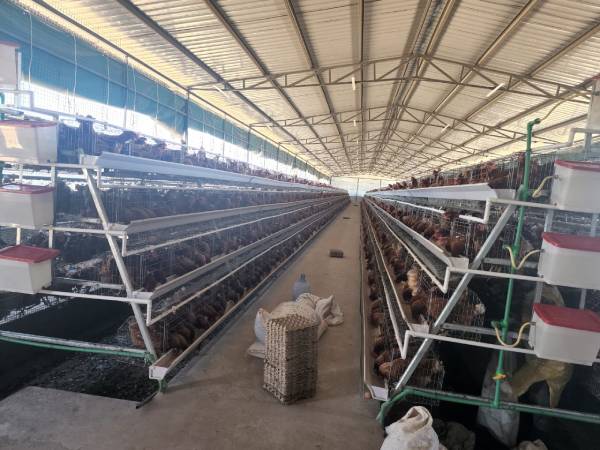
Typical capacity:
Each cage unit holds 120-160 layers
Suitable for farms raising:
-
10,000 layers
-
15,000 layers
These cages are ideal for farmers transitioning from small-scale to commercial egg production.
H-Type Layer Chicken Cage
H-type cages are designed for large-scale commercial poultry farms.
Main advantages:
-
Higher automation level
-
Better space utilization
-
Automatic egg collection
-
Automatic feeding system
-
Automatic manure removal system

H-type systems are typically installed in farms raising:
20,000 layers
30,000 layers
50,000 layers or more
Poultry Project Case 1: 10,000 Layers Farm in Tanzania
One example of a successful poultry farm project is a 10,000-layer egg farm located near Dodoma.
Project Background
The farmer originally raised 2,500 chickens using a deep litter system. However, as egg demand increased in the region, the farmer decided to expand production using A type layer battery cages.
The poultry house dimensions:
64m × 8m × 3.5m
Equipment Configuration
The farm installed a 4-tier A-type battery cage system supplied by LIVI Poultry Equipment.
System details:
-
4-tier layer cages
-
Capacity per cage unit: 160 birds
-
Total cage sets: 64
-
Two cage rows inside the poultry house

Supporting equipment included:
-
Automatic nipple drinking system
-
Semi-automatic feeding machine
-
Egg collection trays
-
Manure cleaning system
Installation Timeline
Equipment manufacturing: 18 days
Shipping to Tanzania: about 35 days
Installation: 15 days
The entire farm was operational within two months from order confirmation.
Production Performance
After switching to cage farming, the farm achieved:
Egg production rate: 92% during peak laying
Feed waste reduction: about 4%
Labor reduction: from 6 workers to 3 workers
The improved efficiency significantly increased the farm’s profitability.
Poultry Project Case 2: 20,000 Layers Farm in Tanzania
Another large project was installed for a commercial poultry farm near Arusha.
Farm Overview
Farm capacity: 20,000 layers
Chicken house size: 100m × 8m × 4m
The farm was designed for commercial egg supply to local supermarkets and food distributors.
Equipment Solution
The farm adopted a 4-tier H-type automatic layer cage system provided by LIVI Poultry Equipment.
Automation systems included:
-
Automatic feeding machine
-
Automatic egg collection system
-
Automatic manure removal
-
Nipple drinking line

Production Benefits
Compared with manual systems, the farm achieved:
Labor savings of 50%
Higher egg collection efficiency
Cleaner eggs for commercial packaging
More stable flock management
Cost of Battery Chicken Cage Systems in Tanzania
The cost of a battery chicken cage for sale depends on several important factors.
Farm Capacity
The number of chickens directly affects equipment investment.
Typical poultry farm sizes include:10,000 layers farm
20,000 layers farm
30,000 layers commercial farm
Larger farms benefit from lower cost per chicken due to scale efficiency.
Cage Material Quality
Most commercial poultry cages are made from hot-dip galvanized steel.
Advantages include:
-
Strong corrosion resistance
-
Long service life (15–20 years)
-
Durable structure in tropical climates
Automation Level
Farmers can choose different levels of automation.
Basic systems
Manual feeding
Manual egg collection
Semi-automatic systems
Feeding machine
Nipple drinking system
Fully automatic systems
Egg conveyor belts
Manure removal systems
Automatic feeding
Automation increases the initial investment but significantly reduces labor costs.
How to Choose a Reliable Poultry Equipment Supplier
Choosing a professional poultry equipment manufacturer is essential for farm success.
Farmers should evaluate suppliers based on:
Manufacturing experience
Engineering design capability
Export experience to Africa
Installation guidance
After-sales service

LIVI Poultry Equipment specializes in commercial poultry equipment and provides customized poultry house solutions for farms across Africa.
The company has delivered projects in multiple countries including:
-
Nigeria
-
Kenya
-
Ghana
-
Uganda
-
Tanzania
This experience allows them to design equipment suitable for African poultry farming environments.
Is a Battery Cage System Suitable for Your Farm?
Battery cage systems are recommended for farmers who:
-
Plan to raise more than 3,000 layers
-
Want to improve egg production efficiency
-
Need to reduce labor costs
-
Supply eggs to urban markets
-
Plan long-term commercial poultry farming
With the right equipment and management, battery cage systems can significantly improve poultry farm productivity and profitability.
FAQ: Battery Chicken Cage for Sale in Tanzania
What is the capacity of a battery chicken cage?
Most cage units hold 120-160 layers, depending on cage design and tier configuration.
How long does poultry cage installation take?
For farms raising 10,000–20,000 chickens, installation typically takes 7–15 days.
How long do galvanized poultry cages last?
High-quality hot-dip galvanized cages can last 15–20 years with proper maintenance.
What farm size is suitable for battery cage systems?
Battery cages are generally recommended for farms with at least 3,000 laying hens.