
Uganda Layer Battery Cage Project Guide
50,000 Chicken Layer Battery Cage Project in Uganda
To build a 50,000 chicken layer battery cage project in Uganda, the recommended solution is a fully automatic H-type layer battery cage system with automatic feeding, drinking, manure removal, egg collection, ventilation, cooling pad and environment control. For this project scale, Livi Machinery recommends using H-type layer battery cages because they save land, reduce labor, improve egg collection efficiency and support commercial egg production management.
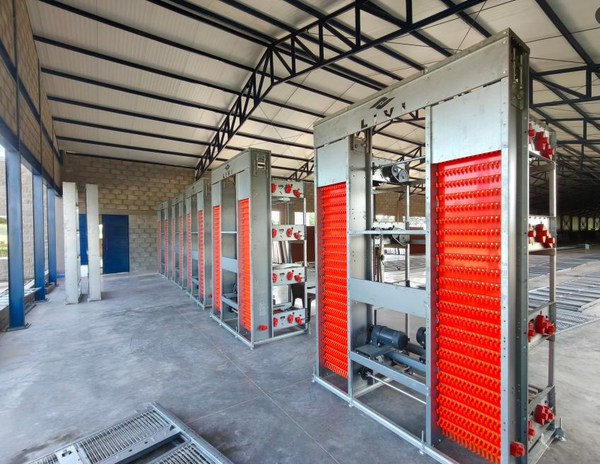
H-type layer battery cage systems are suitable for large commercial egg farms that need land saving and automatic operation.
Why Choose H-Type Layer Battery Cages for 50,000 Layers in Uganda?
For a 50,000-layer project, H-type layer battery cages are more suitable than traditional A-type cages because they provide higher bird density, easier automatic management and better manure removal efficiency. Uganda poultry investors usually need to control land use, labor cost and daily management difficulty, so a compact and automatic cage system is more practical.
The layer battery cage system for commercial egg farms can be combined with automatic feeding, automatic drinking, manure removal, egg collection and ventilation control. This makes the project easier to operate than a manual or semi-automatic poultry house.
| Item | A-Type Layer Cage | H-Type Layer Battery Cage | Recommendation for 50,000 Layers |
|---|---|---|---|
| Suitable scale | 10,000–20,000 layers | 20,000–100,000+ layers | H-type cage is recommended |
| Birds per set | 160 birds/set | 192 birds/set | Higher capacity per cage set |
| Land use | Requires more house area | Saves house length and land | Better for commercial expansion |
| Automation | Can be semi-automatic | Designed for full automation | More suitable for 50,000 layers |
How Many H-Type Layer Battery Cage Sets Are Needed?
The cage quantity should be calculated according to the bird capacity of each cage set. For this Uganda project, the recommended cage model is the 4-tier 4-door H-type layer battery cage with 192 birds per set.
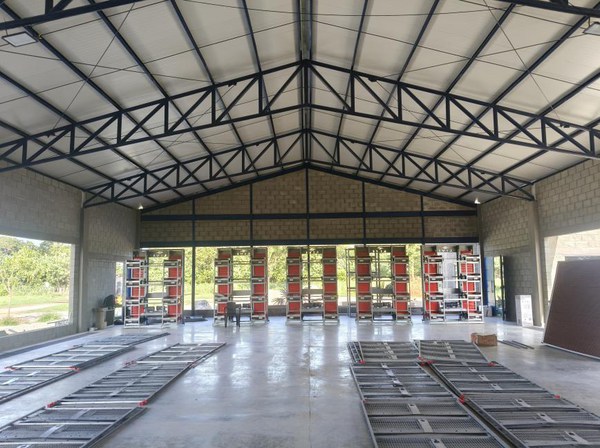
A properly designed chicken house should match the cage rows, aisles, feeding lines, manure belts, egg collection system and ventilation equipment.
Total birds ÷ Birds per cage set = Required cage sets
50,000 layers ÷ 192 birds/set ≈ 261 sets
In actual project design, it is better to reserve a small capacity margin for flock grouping, future management and installation layout. Therefore, about 262–264 sets are recommended for a 50,000-layer battery cage project.
| Cage Model | Specification | Capacity | Calculation for 50,000 Layers | Suggested Quantity |
|---|---|---|---|---|
| 4-tier 2-door H-type cage | 1200mm × 625mm × 480mm | 144 birds/set | 50,000 ÷ 144 ≈ 348 sets | Not the first choice |
| 4-tier 4-door H-type cage | 1800mm × 600mm × 430mm | 192 birds/set | 50,000 ÷ 192 ≈ 261 sets | 262–264 sets |
How Many Chicken Houses Should Be Built for This Uganda Project?
If the land size is not limited, two chicken houses are recommended for a 50,000-layer project in Uganda. Each house can hold about 25,000 layers. This layout reduces management risk, improves ventilation control and makes phased production easier.
If land saving is the main target, one larger closed chicken house can also be considered. However, one-house design requires stronger ventilation design, better manure removal planning and more careful daily operation.
| Layout Option | House Quantity | Estimated House Size | Cage Arrangement | Suitable Situation |
|---|---|---|---|---|
| Recommended layout | 2 houses | About 70m × 15m × 4.2m per house | 4 rows of H-type cages per house | Better flock management and ventilation |
| Land-saving layout | 1 house | About 90–95m × 21m × 4.5m | 6 rows of H-type cages | Limited land and centralized management |
Before confirming the house size, investors should compare different commercial chicken cages for poultry farms according to farm capacity, land size, labor plan and automation level.
What Automatic Poultry Battery Cage Equipment Is Required?
A 50,000-layer farm should not rely on manual feeding, manual manure cleaning or manual egg collection. The daily workload is too high, and management mistakes can directly affect egg production. A full automatic poultry battery cage system is recommended for stable operation.
For a 50,000-layer project, the automatic poultry battery cage system should include feeding, drinking, manure removal, egg collection, ventilation and environment control.
| System | Recommended Configuration | Function | Value for 50,000 Layers |
|---|---|---|---|
| Automatic feeding | Feed silo, feed line, hopper feeding trolley | Distributes feed evenly to each cage row | Reduces labor and feed waste |
| Automatic drinking | Nipple drinkers, water line, pressure regulator | Provides clean water continuously | Supports stable laying performance |
| Automatic manure removal | Belt manure removal system | Removes manure from each tier | Improves air quality and biosecurity |
| Automatic egg collection | Egg belts, elevator, collection table | Collects eggs from cage rows to front table | Reduces broken eggs and labor cost |
| Ventilation and cooling | Fans, cooling pads, air inlets, controller | Controls heat, humidity and ammonia | Important for Uganda hot seasons |
How to Build the 50,000-Layer Battery Cage Farm Step by Step?
A 50,000-layer project should be planned as a complete production system, not only as cage purchasing. The project should include land planning, house size confirmation, cage layout, automatic equipment configuration, ventilation design, installation schedule and operation training.
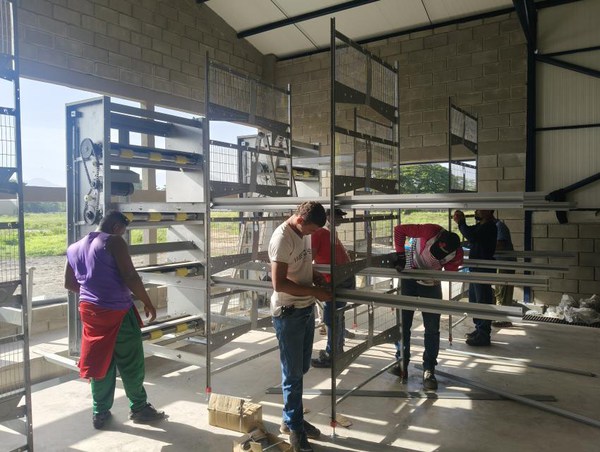
The cage system layout should be confirmed before chicken house construction to avoid wrong aisle width, ventilation position or equipment installation space.
- Confirm project capacity: 50,000 layers, production target and future expansion plan.
- Confirm land condition: land width, length, road access, drainage and power availability.
- Select cage system: 4-tier 4-door H-type layer battery cage with 192 birds/set.
- Design chicken house layout: choose one-house or two-house layout according to land and management plan.
- Configure automation: feeding, drinking, manure removal, egg collection, ventilation and cooling system.
- Prepare construction: foundation, floor, wall, roof, doors, ventilation opening and equipment access.
- Install equipment: cage frame, feed line, water line, manure belt, egg collection and control cabinet.
- Test operation: run motors, water pressure, feeding trolley, manure belt, egg belt and ventilation controller.
- Start flock management: transfer birds after equipment inspection and staff training.
Investors who are comparing different layer chicken cages for egg production should confirm cage model, house size and automation level before construction starts.
How Should Ventilation Be Designed for Uganda Climate?
Uganda layer farms should pay attention to heat, humidity, ammonia and air exchange. For a 50,000-layer farm, ventilation design should not only depend on wall openings. A high-density H-type cage house needs mechanical ventilation and cooling support.
Livi ventilation design usually considers bird quantity, house size, cage row arrangement, local temperature, humidity, wind direction and power condition. In a closed or semi-closed poultry house, exhaust fans and cooling pads are commonly used to maintain a more stable environment.
What should be controlled?
Temperature, humidity, ammonia, dust, air speed and fresh air volume should be checked during daily operation.
What equipment is needed?
Fans, cooling pads, air inlets, control cabinet and temperature sensors are usually required for high-density cage houses.
Why is it important?
Poor ventilation can increase heat stress, wet manure, ammonia level and disease pressure inside the chicken house.
How Much Does a 50,000 Chicken Layer Battery Cage Project Cost?
The cost of a 50,000-layer battery cage project in Uganda depends on cage model, automation level, chicken house structure, ventilation design, shipping, installation and local construction cost. The cage system is only one part of the total investment.
Livi Machinery works as a chicken battery cage system supplier for commercial poultry farms that need cage layout, automatic equipment configuration and installation guidance.
| Cost Component | Included Items | Cost Impact | Planning Note |
|---|---|---|---|
| Cage system | H-type cages, frames, troughs, accessories | High | Choose model according to capacity and house layout |
| Automatic feeding | Feed silo, feed line, trolley, motors | Medium to high | Important for labor saving |
| Egg collection | Egg belts, elevator, collection table | Medium | Recommended for 50,000 layers |
| Ventilation and cooling | Fans, cooling pads, controller, sensors | Medium to high | Must match Uganda climate and house size |
What Is the Daily Operation SOP for a 50,000-Layer Cage Farm?
A large layer farm needs standard daily operation. The purpose of SOP is to reduce random management, detect problems early and keep egg production stable.
| Time | Operation | Inspection Point | Target Result |
|---|---|---|---|
| Morning | Check water, feed, temperature and bird condition | Nipple drinkers, feed troughs, abnormal birds | Ensure normal start of daily production |
| Before feeding | Run automatic feeding system | Feed distribution and motor operation | Even feed supply to all cage rows |
| Midday | Check ventilation and cooling system | Fan, cooling pad, controller, house temperature | Reduce heat stress |
| Afternoon | Collect eggs automatically | Egg belt, broken eggs, collection table | Improve egg handling efficiency |
| Scheduled | Run manure removal system | Manure belt, scraper, discharge point | Keep air quality and hygiene stable |
FAQ About 50,000 Chicken Layer Battery Cage Project in Uganda
How many workers are needed for a 50,000-layer cage farm?
With automatic feeding, drinking, manure removal and egg collection, a 50,000-layer farm can operate with far fewer workers than a manual farm. The exact number depends on egg packing, manure handling, feed management and biosecurity rules. Workers are mainly responsible for inspection, egg handling, equipment checking, bird health observation and cleaning.
Is H-type cage better than A-type cage for 50,000 layers?
For 50,000 layers, H-type cage is usually better because it saves land and supports full automation. A-type cage is more suitable for 10,000–20,000 layers or projects with lower automation budgets. If the farm wants commercial egg production, labor saving and easier manure management, H-type layer cage is the more practical option.
How many H-type cage sets are needed for 50,000 chickens?
If using the 4-tier 4-door H-type layer cage with 192 birds per set, the calculation is 50,000 ÷ 192 ≈ 261 sets. In real layout planning, about 262–264 sets are recommended to provide a small capacity margin and make the cage row arrangement easier.
What chicken house size is recommended?
A practical option is to build two houses, each about 70m × 15m × 4.2m, with around 25,000 layers per house. If the farm needs one centralized house, an estimated size of 90–95m × 21m × 4.5m can be considered. Final dimensions should be confirmed according to cage rows, aisle width and ventilation plan.
Is automatic egg collection necessary for this project?
For 50,000 layers, automatic egg collection is strongly recommended. Manual egg collection requires more labor and increases the risk of broken eggs, missed eggs and inconsistent daily operation. An automatic egg collection system can collect eggs from cage rows to the front collection area, making egg handling more efficient.
Need a 50,000-Layer Battery Cage Layout for Uganda?
If you are planning to build a 10,000–100,000+ layers poultry farm in Uganda, Livi Machinery can provide customized cage layouts, automatic equipment configuration, chicken house planning, ventilation design and installation guidance according to your land size, climate, power condition and investment plan.
Share your bird quantity, chicken house size, land plan and automation requirements. Livi engineers can prepare a practical layout for your commercial egg farm project.