
Layer Hen House Cost Guide
How Much Does It Cost to Build a 20,000-Bird Layer Hen House with Cages?
The cost to build a 20,000-bird layer hen house equipped with cages depends on the cage model, chicken house structure, automation level, ventilation design, shipping distance, installation support and local construction cost. For most 20,000-layer projects, A-type layer cages are usually more cost-effective, while H-type layer battery cages are suitable when the farm needs higher density, automatic egg collection, land saving and future expansion.
What Is the Quick Cost Summary for a 20,000-Bird Layer Hen House?
A 20,000-bird layer hen house cost should be planned as a complete production system, not only as a cage purchase. The main budget usually includes cages, drinking system, feeding method, manure removal, egg handling, ventilation, lighting, chicken house construction, shipping and installation support.
| Item | Planning Reference | Why It Matters |
|---|---|---|
| Farm capacity | 20,000 laying hens | Determines cage quantity, house size, water demand, feed delivery and ventilation volume. |
| Recommended cage type | 4-tier 5-door A-type layer cage | Usually more cost-effective for 20,000 layers than a full H-type system. |
| Estimated cage sets | 125 sets | Calculated by 20,000 birds ÷ 160 birds per set. |
| Suggested house size | About 80m × 12m × 3.5m for one-house planning reference | Final size depends on cage rows, aisle width, manure area, ventilation and local construction rules. |
| Major cost drivers | Cage model, house structure, automation, ventilation, shipping and installation | These factors decide whether the project is low-budget, semi-automatic or high-automation. |
Swipe left/right to view the full table on mobile.
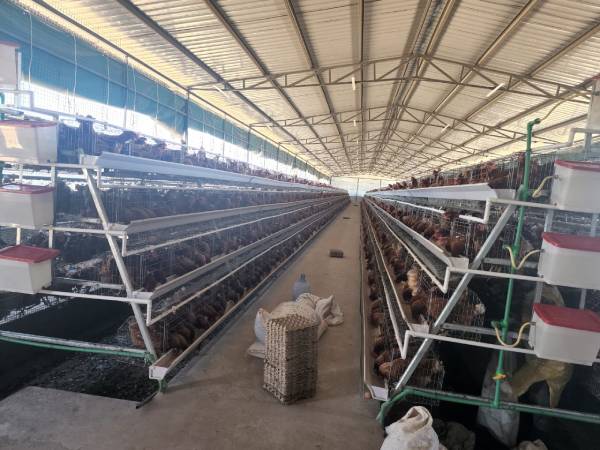 A layer hen house budget should compare cage model, house structure, automation level and future expansion requirements before construction.
What Is Included in the Cost of a 20,000-Bird Layer Hen House?
The cost includes both equipment and construction. Many new investors only calculate the cage price, but a real layer hen house budget also includes the building, water system, feed system, manure handling, egg handling, ventilation, lighting, electrical control, transport and installation support.
If the farm is comparing chicken cages for sale, the cage price should be evaluated together with house dimensions, automation level and long-term labor cost.
| Cost Component | Included Items | Cost Impact | Can It Be Adjusted? | Planning Note |
|---|---|---|---|---|
| Layer cage system | Cages, frames, feed troughs, accessories, installation parts | High | Yes | A-type cages usually reduce initial cost for 20,000 layers. |
| Chicken house construction | Foundation, floor, wall, roof, drainage, doors, ventilation openings | High | Partly | Local material and labor cost strongly affect the final budget. |
| Automatic drinking system | Nipple drinkers, water pipes, pressure regulators, water tank | Medium | No for cage farms | Clean and stable water supply is a basic requirement. |
| Feeding system | Manual feeding, semi-automatic feeding or feed trolley | Medium to high | Yes | Automatic feeding reduces labor but increases initial equipment cost. |
| Manure removal | Manual cleaning, scraper system or belt manure removal | Medium | Yes | Better manure removal improves air quality and daily hygiene. |
| Ventilation and cooling | Fans, curtains, air inlets, cooling pads, controller | Medium to high | Partly | Hot or humid climates need stronger ventilation planning. |
| Shipping and installation | Container loading, sea freight, port fees, installation guidance | Medium to high | Partly | Destination country and installation method affect the cost. |
Swipe left/right to view the full table on mobile.
How Many Layer Cage Sets Are Needed for 20,000 Birds?
Cage quantity is one of the first calculations in the budget. For most 20,000-layer projects, Livi Machinery recommends the 4-tier 5-door A-type layer cage with a capacity of 160 birds per set.
 Cage quantity should be calculated before confirming house size, aisle width, ventilation direction and automation configuration.
Total Birds ÷ Birds Per Set = Required Cage Sets
20,000 layers ÷ 160 birds/set = 125 cage sets
In real project layout, a small capacity margin is usually reserved for cage row arrangement, flock grouping and installation planning. If the farm plans to expand later, the house and land layout should reserve space for future cage rows.
| Cage Model | Specification | Birds Per Set | Calculation | Suggested Quantity | Budget Note |
|---|---|---|---|---|---|
| 4-tier 5-door A-type layer cage | 1950mm × 450mm × 410mm | 160 birds/set | 20,000 ÷ 160 = 125 sets | 125 sets | Recommended for cost control in 20,000-layer projects. |
| 4-tier 4-door H-type layer battery cage | 1800mm × 600mm × 430mm | 192 birds/set | 20,000 ÷ 192 ≈ 105 sets | About 105 sets | Optional upgrade for higher density and automation. |
Swipe left/right to view the full table on mobile.
How Does A-Type vs H-Type Cage Affect the Budget?
A-type and H-type cage systems affect the budget in different ways. A-type layer cages usually have a lower initial investment and are suitable for 5,000–30,000 layers. H-type layer battery cages support higher density and stronger automation, but the total project cost is usually higher.
For a 20,000-bird farm, layer chicken cages should be selected according to budget, labor cost, land size and future expansion plan.
| Factor | A-Type Layer Cage | H-Type Layer Battery Cage | Budget Suggestion for 20,000 Birds |
|---|---|---|---|
| Initial cage investment | Lower | Higher | A-type is usually better for first-stage cost control. |
| House structure requirement | Moderate | Higher and stronger house required | A-type is easier for open or semi-open houses. |
| Automation compatibility | Manual, semi-automatic or automatic | More suitable for full automation | Choose H-type if labor saving is the top priority. |
| Land saving | Medium | High | H-type is better if land is limited. |
| Future expansion | Suitable for medium farms | Suitable for large commercial farms | Choose H-type if expansion to 50,000+ layers is planned. |
Swipe left/right to view the full table on mobile.
What Chicken House Size and Structure Affect the Cost?
Chicken house cost depends on the house type, building material, roof design, floor thickness, drainage, ventilation openings, manure discharge area, egg room and feed storage room. The same 20,000-bird cage system can have different total costs if the building structure is different.
For a 20,000-layer A-type cage project, a planning reference is about 80m × 12m × 3.5m for one house, or two houses of about 45m × 12m × 3.5m each. Final dimensions should be adjusted according to cage rows, aisle width, ventilation design and local construction conditions.
| House Cost Factor | Common Options | Cost Impact | Planning Recommendation |
|---|---|---|---|
| House type | Open house, semi-open house, closed house | Medium to high | Open or semi-open house is usually more economical. |
| Structure material | Steel structure, brick wall, mixed structure | High | Select according to local material cost and climate. |
| Roof system | Single roof, insulated roof, heat-reflective material | Medium | Hot regions may need better heat insulation. |
| Floor and drainage | Concrete floor, drainage slope, manure area | Medium | Good drainage reduces long-term hygiene problems. |
| Ventilation design | Side curtains, fans, air inlets, cooling pads | Medium to high | Ventilation should be designed before construction. |
| Service rooms | Egg room, feed room, tool room, power room | Low to medium | Reserve space to improve daily operation efficiency. |
Swipe left/right to view the full table on mobile.
What Automatic Equipment Adds to the Project Cost?
Automatic equipment increases the initial investment, but it can reduce labor cost, improve feeding consistency, keep the house cleaner and make egg handling easier. For 20,000 birds, automatic drinking is basic, while feeding, manure removal and egg collection can be selected according to budget.
A poultry battery cage system with automatic equipment is more suitable when the investor wants lower labor dependence and more stable daily management.
 Automatic equipment should be selected according to labor cost, management level, egg handling requirements and long-term farm operation.
| System | Recommended Configuration | Cost Impact | Necessary or Optional? | Value for Farm Operation |
|---|---|---|---|---|
| Automatic drinking system | Nipple drinkers, water lines, regulators, water tank | Medium | Necessary | Provides clean and stable water to every cage level. |
| Automatic feeding system | Feed silo, feed line, hopper, feeding trolley | Medium to high | Recommended | Reduces manual feeding workload and feed distribution errors. |
| Manure removal system | Scraper manure removal or belt manure removal | Medium | Recommended | Improves hygiene, air quality and disease prevention. |
| Automatic egg collection system | Egg belt, elevator, front collection table | Medium to high | Optional upgrade | Reduces egg handling labor and broken egg risk. |
| Ventilation and cooling system | Fans, air inlets, cooling pads, controller | Medium to high | Depends on climate | Controls heat, humidity, ammonia and air exchange. |
| Lighting system | LED lights, timer control, wiring | Low to medium | Recommended | Supports stable laying schedule and daily management. |
Swipe left/right to view the full table on mobile.
What Costs Are Often Ignored by New Layer Farm Investors?
New investors often focus only on cage price and ignore construction details, power supply, water pressure, spare parts, installation tools, manure handling and future expansion space. These ignored items may not look large at the beginning, but they can affect daily operation later.
| Often Ignored Cost | Why It Matters | How to Plan |
|---|---|---|
| Power supply and wiring | Motors, lighting, fans and controllers need stable power. | Confirm voltage, phase and backup power before quotation. |
| Water pressure and storage | Drinking system performance depends on stable water supply. | Prepare water tank, filters and pressure regulation. |
| Manure discharge area | Poor manure handling creates odor, flies and disease pressure. | Reserve manure drying, collection or removal space. |
| Egg storage and packing space | Eggs need clean, shaded and organized handling areas. | Plan a simple egg room near the collection side. |
| Installation tools and local labor | Equipment installation needs workers and basic tools. | Prepare local team before goods arrive. |
| Future expansion space | Expanding later is difficult if the house and land are fully occupied. | Reserve land and leave space for future cage rows or another house. |
Swipe left/right to view the full table on mobile.
How to Plan the Budget Step by Step?
A good budget plan starts with farm capacity and ends with a detailed equipment and house layout. The goal is not to choose the cheapest system, but to match the cage system, chicken house, automation level and operation plan.
Before ordering A type layer cage and H type layer battery cage options, the farm should confirm whether the first priority is low investment, labor saving, land saving or future expansion.
- Confirm bird quantity: decide whether the project is exactly 20,000 layers or will expand later.
- Select cage type: choose A-type layer cage for cost control or H-type layer battery cage for higher automation.
- Calculate cage sets: use birds per cage set to calculate the required quantity.
- Plan chicken house size: match cage rows, aisle width, roof height, ventilation and manure area.
- Choose automation level: decide manual, semi-automatic or full automatic operation.
- Check local utilities: confirm water supply, voltage, power stability and backup power.
- Plan logistics: calculate container loading, shipping route, port and inland transport.
- Prepare installation: arrange local workers, tools, foundation and installation sequence.
- Review total budget: compare equipment cost, house cost and long-term operation cost together.
What Is the Daily Operation Cost SOP?
Daily operation cost is affected by feed distribution, water management, egg handling, manure removal, ventilation and equipment maintenance. A clear SOP helps reduce waste and avoid hidden long-term costs.
| Time / Frequency | Operation | Cost Item Affected | Inspection Point | Target Result |
|---|---|---|---|---|
| Daily morning | Check water and feed supply | Water cost, feed waste, bird health | Nipple drinkers, water pressure, feed troughs | Prevent dehydration and uneven feeding. |
| Daily | Observe bird condition | Mortality loss and treatment cost | Weak birds, abnormal behavior, dead birds | Detect problems early. |
| Daily or scheduled | Collect eggs | Egg damage and labor cost | Broken eggs, dirty eggs, collection records | Improve egg quality and handling efficiency. |
| Scheduled | Remove manure | Labor cost, hygiene cost, disease risk | Manure pit, scraper, belt, discharge area | Keep the house clean and reduce ammonia. |
| Daily hot period | Check ventilation and cooling | Electricity cost and heat stress loss | Fans, air inlets, cooling pads, temperature | Reduce heat stress and production loss. |
| Weekly | Check motors and moving parts | Maintenance and repair cost | Feeding motor, manure system, egg belt | Prevent equipment failure. |
Swipe left/right to view the full table on mobile.
FAQ About 20,000-Bird Layer Hen House Cost
How much does it cost to build a 20,000-bird layer hen house?
The cost cannot be answered by one fixed price because it depends on cage model, chicken house structure, automation level, ventilation design, shipping distance, installation method and local construction cost. For a 20,000-bird project, A-type layer cages are usually more suitable for budget control, while H-type cages increase automation and land-saving potential.
What is the biggest cost in a layer cage farm?
The biggest cost is usually divided between the cage system and chicken house construction. The cage system includes cages, accessories, drinking lines and optional automatic systems. The house construction includes foundation, floor, wall, roof, drainage and ventilation openings. In some countries, local building material and labor cost can be as important as equipment cost.
Is A-type cage cheaper than H-type cage?
In most 20,000-layer projects, A-type cages have a lower initial investment than H-type layer battery cages. A-type cages are easier to use in open or semi-open houses and can support manual or semi-automatic operation. H-type cages are better for higher density, automatic egg collection, land saving and future expansion, but the total project budget is usually higher.
Is automatic feeding necessary for 20,000 layers?
Automatic feeding is recommended but not always required for 20,000 layers. If labor cost is low and the investor wants to reduce initial investment, manual or semi-automatic feeding can be used. If the farm wants more stable feed distribution, less labor pressure and easier daily management, automatic feeding is a better long-term choice.
Does the chicken house cost more than the cage system?
It depends on local construction cost and house type. A simple open or semi-open house may cost less than a closed house with fans, cooling pads and insulation. In some markets, the chicken house, foundation, roof and local labor can become a major part of the total investment. This is why equipment and construction should be planned together.
Can I start with semi-automatic equipment and upgrade later?
Yes. Many 20,000-layer farms start with A-type cages, automatic drinking, manual or semi-automatic feeding and basic manure removal. Later, they may upgrade feeding, manure removal or egg collection systems. However, the chicken house should reserve enough space and electrical capacity for future equipment installation from the beginning.
What information is needed for an accurate quotation?
To prepare an accurate quotation, Livi Machinery needs the bird quantity, cage type preference, chicken house size, land dimensions, automation requirements, local voltage, water supply condition, destination port and whether installation guidance is required. These details help calculate cage quantity, equipment configuration, container loading, shipping plan and project budget.
Need a 20,000-Bird Layer Hen House Budget Plan?
If you are planning a 20,000-bird layer hen house equipped with cages, Livi Machinery can help calculate cage quantity, compare A-type and H-type cage options, plan the chicken house layout, configure automatic feeding, drinking, manure removal and ventilation systems, and prepare a budget plan according to your land size, house type and automation requirements.
Share your bird quantity, chicken house size, land plan, automation level and destination country. Livi engineers can prepare a practical cost breakdown for your layer cage farm project.