
The environment in the poultry house affects the health and well-being of laying hens. Diseases related to the respiratory and digestive systems are more likely to occur when the climatic conditions are unfavorable. In addition to this, laying hens may develop behavioral problems. Growth and productivity can also be negatively affected when temperature conditions are not up to standard.
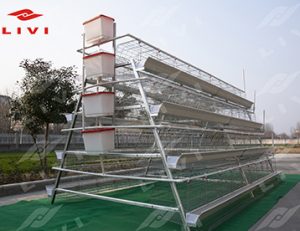

The suitable temperature for a layer cage system environment
Temperature affects chicken egg production. Cold weather, especially extreme changes, can cause hens to stop laying eggs. However, other factors can cause a chicken to stop laying eggs.
Too hot to handle: Extreme heat or cold may cause your chickens to stop laying eggs. Heat has a greater effect on chicken egg production than cold. Chickens lay well when the ambient temperature is between 11 and 26 degrees Celsius (or about 52 and 79 degrees Fahrenheit). Below this temperature, egg production will decrease. However, the hearty winter variety will continue to spawn as long as there is adequate food and water.
Seasonal changes: Once the chickens start laying, they need 14 hours of light to continue laying. After the summer solstice in June in the northern hemisphere, the amount of light begins to decrease and continues to decrease until after the winter solstice in December. Often, chicken owners believe that their hens have stopped laying because of cooler temperatures rather than a lack of light. Chicken owners can remedy this by adding enough artificial light to make up for the lack of daylight.
Therefore, The critical temperature of adult laying hens is 18°C. Chickens need an additional 1 gram of feed per day for every 1°C below 18°C. Measuring temperature is easy and inexpensive. There are different types of thermometers available, and it is wise to have more than one throughout the house, this will give you a better idea of possible temperature differences in the house and make it easier to find out if there is damage.
There are two types of temperature measurement
- Actual air temperature measured by a thermometer
- Effective temperature, which is the temperature felt by the bird. The effective temperature increases when the humidity increases, but decreases as the air movement increases.
How we should place the thermometer?
First, place them where it’s easy to read the temperature, i.e. not too high up. Due to uneven temperatures in the house, it is not recommended to place them close to the walls as airflow is usually lowest in these locations. Consider the location of air intakes (when you have closed coops), ventilation locations, and heaters (for brooding). It is recommended that the thermometer be placed as close to the animal as possible, as this will give the best indication of the temperature they are experiencing. Place them where fresh air passes through the thermometer before it reaches the birds.
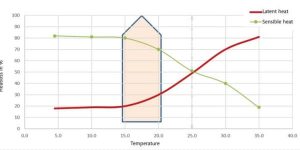
The temperature zone for a layer cage system environment
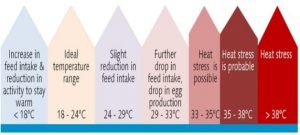
The thermoneutral zone (also known as the comfort zone) is defined as the temperature zone where birds can maintain a constant body temperature with minimal effort. This comfort zone depends on environmental conditions, so in addition to temperature, consider relative humidity! When the temperature of the chicken house increases, the layers will change. Layers will become less active, consume less feed, and fluff up while hanging their wings to expand air movement in contact with the body. Both egg production and egg size will decrease due to reduced feed intake. If the temperature rises further, the birds will further reduce their feed intake, and they will start panting to lower their body temperature.
And vice versa, when the temperature is below the comfort zone of the layers, they try to keep warm: feed intake increases because the energy in the feed can be used to keep the birds warm, and you see birds huddling together to keep warm. Keep each other warm.
In the thermoneutral zone, the ratio of water to feed is about 2:1. As temperatures rise, layer hens simply consume less feed while drinking more water to stay cool, but they also drink more water due to panting, which generates more heat through muscle activity.
The good light for the layer cage system environment
In the middle of the two light sources, the trough of the bottom cage measures the minimum light intensity. Keep bulbs clean to prevent loss of light intensity.
- Prevents dark areas caused by excessive bulb spacing or burnt-out bulbs.
- The location of the light source can minimize the bright and dark areas of the house.
- Use glossy or white reflectors to increase light intensity.
- Make appropriate adjustments to the lighting program according to the actual situation.
- Lighting times in the rearing and laying pens should match when transferring.
- Gradually increase the light intensity 2 weeks before the chickens transfert to the laying hen house (but not before 14 weeks of age), and the final light intensity of the brooding hen house should match the light intensity of the laying hen house.
- When the body weight of the 17-week-old flock reaches the target body weight (1.23-1.27 kg), light stimulation is started. If the body weight of the flock is not up to the standard or the uniformity is poor, the light stimulation is delayed
- Light stimulation should be extended until peak lay (16 hours of light at approximately 30 weeks of age).
- The distribution of high and low light sources is conducive to improving the uniformity of illumination in different layers of cages.
The relationship between temperature and Relative Humidity
In many cases, egg producers are focused too much on the barn temperatures. Relative Humidity is often overlooked. But the climate inside the barn, which defines if the bird feels comfortable or not, is the result of the interaction between the temperature and the relative humidity.
The golden standard is that the sum of the temperature and the relative humidity should be around 90.
|
Sum of T °C + % RH |
Results in |
|
90 |
The birds feel comfortable |
|
< 80 |
Cold / poor air |
|
> 100 |
Sweltering (hot and humid) |
|
> 115 |
Fatal consequence |
|
Sum of T °C + % RH |
Feels like |
|
25°C + 45% RH = 70 |
23°C |
|
25°C + 55% RH = 80 |
24°C |
|
25°C + 65% RH = 90 |
25°C |
|
25°C + 75% RH = 100 |
26.5°C |
|
25°C + 85% RH = 110 |
28°C |
Practical and cost-effective tips for layer cage system environment
-
Planting tall trees near the coop creates shade as the moisture from the trees evaporates and the surrounding air cools, making for a more comfortable climate inside the poultry coop. Try to grow them in a way that doesn’t impede airflow. Keep biosecurity in mind as trees may attract wild birds and rodents. Make sure you have an effective biosecurity program in place to protect the health and well-being of your layer hens.
-
A well-maintained lawn around a home will keep indoor temperatures cooler than bare ground, rock, or concrete. Grass radiates less heat than concrete or ground.
-
After installing the cages, be sure to make sure the feed boxes are connected to the cages on both sides of the hallway. The coldest air is usually found in the corridors, which will help the hens dissipate heat more easily.
-
The tank is best stored inside, where there is less chance of heating through direct sunlight. When placed outside try to protect it with a wet blanket or wet jute as heat is always needed for the evaporation of the wet blanket/jute. Since the heat is coming from the tank, it will keep the water in the tank cool. Painting the tank white cools the water better because heat is reflected rather than absorbed.
create a good environment for laying hens
-
Consider backup power systems as blackout events are usually higher during hot weather/hot seasons. The effects of power bursts are more detrimental during the hot season, and when ventilation ceases, heat stress ensues and can quickly be fatal.
-
An open house can be converted into a power-ventilated house by installing curtains on the open walls. It’s often cost-effective, and you benefit from the best of both worlds.
-
The location of the home is important. It is recommended to be built in an east-west orientation, which prevents direct sunlight from reaching the house. Additionally, this location makes the best use of the wind.
-
Sunlight must not directly shine on the laying hens. Use shutters or an overhanging roof to block direct sunlight from entering the house. Porous curtains are recommended as they block sunlight effectively but allow air to pass through.