
For modern egg farms aiming to improve efficiency and reduce production costs, choosing the right layer cage system is a key investment decision. Among the most widely used systems worldwide, A-type layer cages and H-type layer cages stand out for their durability, performance, and suitability for farms of different scales.
This article provides a clear, practical, and data-driven comparison of the costs associated with the A-type 4-tier 160-bird layer cage and the H-type 4-tier 199-bird layer cage, helping farm owners understand which solution offers better long-term value.

1. Basic Structure and Capacity Differences
Before comparing costs, it is essential to understand the basic structural and functional differences between the two systems.
A-Type 4-Tier 160-Bird Layer Cage
-
Total capacity: 160 layers per set
-
Open, pyramid-like structure
-
Natural ventilation, simple manure removal
-
Lower automation level
-
Lower initial investment
-
Suitable for common poultry farms, especially rural or medium-sized operations

H-Type 4-Tier 199-Bird Layer Cage
-
Total capacity: 199 layers per set (higher density in the same footprint)
-
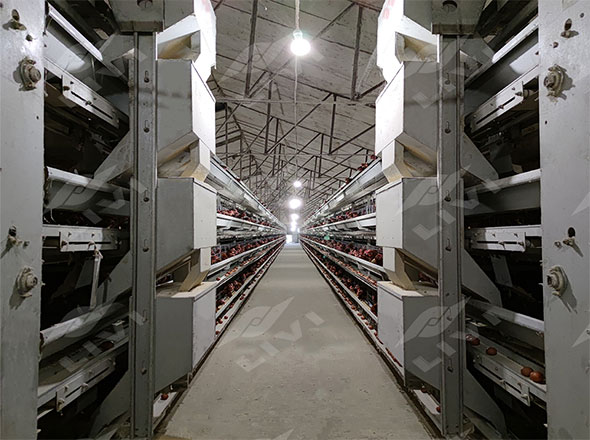
Vertical, fully stacked design
-
High automation: automatic feeding, egg collection, manure removal, and climate control
-
Higher initial investment but lower labor cost
-
Perfect for intensive large-scale cage systems
Because the H-type design can house more chickens within the same land area, it is often considered the premium option for high-tech poultry farms.
2. Cost Breakdown: A-Type vs. H-Type Layer Cage Systems
When evaluating cage systems, poultry farmers should consider both initial investment and long-term operational costs.
(1) Equipment Cost
| Item | A-Type 4-Tier 160 Birds | H-Type 4-Tier 199 Birds |
|---|---|---|
| Cage structure | Lower cost | Higher cost |
| Automation | Optional / partial | Fully automated |
| Accessories | Simple | Medium to advanced |
| Overall price per bird | Low | Medium to high |
A-Type Cost Advantage:
A-type cages require a smaller investment because they are simpler in structure, use less steel, and are often paired with semi-automatic systems.
H-Type Cost Advantage:
Although the H-type cage system costs more, the investment includes advanced machinery that reduces labor costs and improves efficiency.
(2) Installation and Space Cost
Because H-type cages maximize vertical space, the cost per chicken based on land usage is significantly lower.
-
A-type: requires more width, reducing land efficiency
-
H-type: compact stacked design, ideal for houses with limited space
If a farm needs to expand egg production without expanding land, the H-type system offers a clear advantage.

(3) Labor Cost
H-type systems are usually equipped with:
-
Automatic feeding machines
-
Automatic egg collection lines
-
Automatic manure removal belts
-
Ventilation and environmental control systems
This level of automation reduces the number of farm workers needed by 30–50% compared with A-type systems.
A-type systems require more manual labor, especially for:
-
Feeding
-
Monitoring manure removal
-
Collecting eggs
-
Adjusting the environment manually
Thus, long-term labor cost is much higher for A-type systems.

(4) Electricity and Energy Cost
Because the H-type cage system is highly automated, it consumes more electricity compared with the A-type system.
However, the extra electricity use is usually offset by the additional eggs produced due to cleaner environments and reduced stress levels in birds.
In contrast, the A-type system consumes less electricity but has lower production efficiency in comparison with a fully automated environment.
(5) Manure Management Cost
-
A-type often uses a scraper-style system, which is inexpensive but may cause odor and environmental concerns if not maintained well.
-
H-type uses more advanced belt manure removal, reducing ammonia levels and improving layer health.
Healthier chickens mean:
-
Lower mortality
-
Better egg quality
-
Higher feed-to-egg conversion ratio
These factors significantly influence long-term profitability.
3. Productivity Differences and Their Cost Impact
H-Type 4-Tier 199 Birds: Higher Productivity
Studies and industry data suggest that H-type systems generally produce:
-
More eggs per hen due to stable microclimates
-
Cleaner eggs (reducing breakage and contamination)
-
Lower feed waste because feeding systems are automated and precise
A-Type 4-Tier 160 Birds: Moderate Productivity
Traditional A-type cages rely more on natural airflow. This can lead to:
-
Uneven temperatures
-
Higher dust and ammonia levels
-
Slightly lower egg-production efficiency
For farms pursuing large-scale industrial farming, the H-type system is usually the better investment long-term.
4. Total Cost of Ownership (TCO)
To choose the most cost-effective system, farmers must evaluate TCO over 5–10 years, not just the initial purchase price.
A-Type 160-Bird Cage System – TCO Advantages
-
Low upfront cost
-
Low electricity consumption
-
Easy to maintain
-
Suitable for farms with abundant labor
H-Type 199-Bird Cage System – TCO Advantages
-
More chickens per set → higher output
-
Lower labor cost
-
Better manure management → healthier layers
-
Higher automation → consistent production
In most cases, although the H-type system demands a larger upfront investment, it pays itself back faster due to higher productivity and lower labor costs.

5. Which System Should You Choose?
Choose A-Type 4-Tier 160-Bird Layer Cage if:
-
You are running a small or medium farm
-
Your labor costs are low
-
Your budget is limited
-
You prefer simpler management
Choose H-Type 4-Tier 199-Bird Layer Cage if:
-
You operate a medium to large-scale commercial egg farm
-
You want a fully automated production line
-
Labor cost is high in your region
-
You want to maximize profit per square meter
6. Need Reliable Poultry Equipment? Choose LIVI POULTRY EQUIPMENT
If your farm plans to upgrade or expand layer cage systems, LIVI POULTRY EQUIPMENT is a trusted manufacturer known for supplying high-quality A-type and H-type cage systems to more than 80 countries.
Why choose LIVI?
-
13+ years of poultry equipment manufacturing experience
-
High-standard galvanized steel cages
-
Customized design based on farm size and climate
-
Full sets of automatic feeding, drinking, egg collection, and manure removal systems
-
Professional installation and after-sales support
Whether you need cost-effective A-type cages or high-end H-type intensive systems, LIVI delivers durable solutions designed for long-term profitability.
Conclusion
Both A-type and H-type layer cage systems offer unique advantages depending on the farm’s scale and financial goals.
-
The A-type 4-tier 160-bird system provides a budget-friendly, simple, and practical choice suitable for standard farms.
-
The H-type 4-tier 199-bird system, although more expensive upfront, offers superior automation, higher stocking density, and better long-term economic returns.
Choosing the right system can directly impact your farm’s efficiency, production capacity, and profitability. For high-quality poultry equipment and professional project support, LIVI POULTRY EQUIPMENT is an excellent partner to help elevate your poultry business.